

The four DISC personality types are Dominance(D), Influence(I), Steadiness(S), and Conscientiousness(C). Each describes a pattern of behavioral preferences how someone approaches results, relationships, stability, and accuracy. Every person draws on all four styles, so a DISC profile is a starting point for better communication, teamwork, and productivity in the workplace or home.
Take PLI’s free DISC assessment
What Are the 4 DISC Personality Types?
DISC is commonly called a personality test, but it focuses more specifically on behavioral preferences. Different publishers use slightly different names for the same four broad dimensions. PLI uses Dominant, Inspiring, Supportive, and Conscientious.
| Style | Typical focus | Strength | When overused |
|---|---|---|---|
| D Dominant | Results and action | Decisive, direct | Impatient or forceful |
| I Inspiring | Ideas and relationships | Persuasive, enthusiastic | Distracted or overcommitted |
| S Supportive | Trust and stability | Dependable, patient | Avoids necessary conflict |
| C Conscientious | Accuracy and standards | Analytical, thorough | Perfectionistic or slow to decide |
DISC Personality Traits, Strengths and Weaknesses

Dominant (D): Results, Speed and Responsibility
A Dominant personality tends to ask what needs to happen and who will make the decision. D-style strengths include initiative, courage, accountability and willingness to tackle obstacles. The same drive can become impatience, blunt communication or premature certainty. For a DISC dominant personality, a useful adjustment is to ask for the most important risk before deciding and genuinely listen to the answer.
How to communicate: lead with the outcome, offer clear choices and be direct about disagreements. Under pressure, a D-style response may become more controlling; clarity about decision rights helps.
Inspiring (I): Ideas, Energy and Influence
An Inspiring style often generates possibilities, builds rapport and helps people get behind a goal. Strengths include enthusiasm, persuasion, creativity and networking. Overextensions can include too many commitments, weak follow-through or talking past important details.
How to communicate: make room for discussion, then confirm the decision, owner and deadline in writing. Under pressure, an I-style response may become scattered; one visible next action can restore focus.
Supportive (S): Trust, Consistency and Cooperation
A Supportive style often brings patience, listening, reliability and steady execution. These qualities help teams navigate uncertainty. Overused, the preference for harmony can lead to delayed feedback, unspoken concerns or resistance to abrupt change.
How to communicate: explain what is changing and what remains stable, invite concerns explicitly and give time to process. Under pressure, an S-style response may become quiet rather than openly disagreeing; silence should not be assumed to mean consent.
Conscientious (C): Evidence, Quality and Standards
A Conscientious style tends to examine evidence, test assumptions and protect quality. Strengths include precision, organization, analysis and dependable standards. Overextensions include perfectionism, criticism or delaying a decision after enough evidence is available.
How to communicate: provide facts, criteria and the definition of “good enough.” Under pressure, a C-style response may seek more detail; agree on which uncertainties genuinely need resolution.
DISC Strengths and Weaknesses: The Same Trait Can Help or Hurt
The most useful DISC interpretation connects a tendency to its context. Directness helps when a decision is overdue but hurts when colleagues need space to raise risks. Enthusiasm mobilizes people but can distract from execution. Patience builds trust but can delay a difficult conversation. Careful analysis prevents mistakes but can become unnecessary delay.
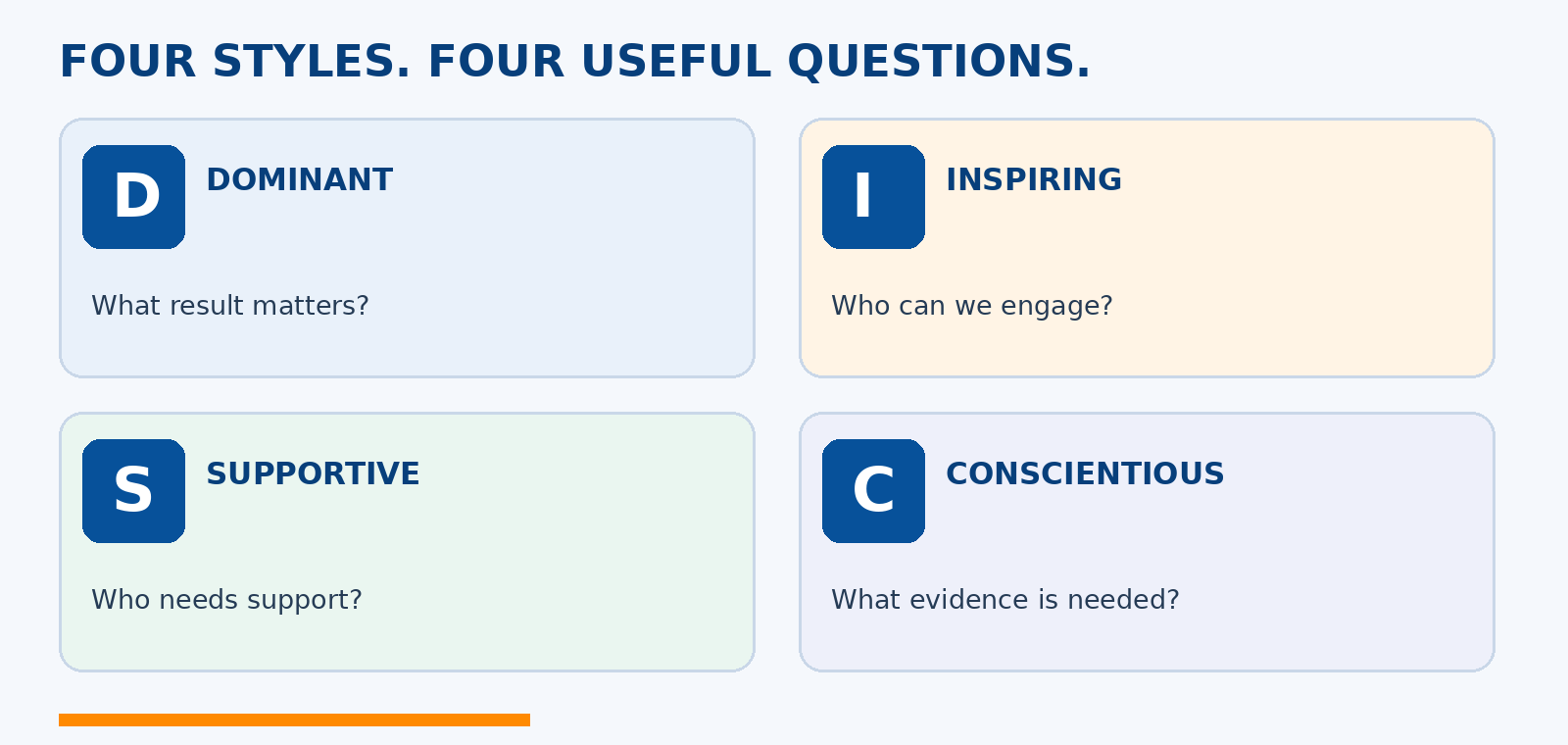
How the DISC Types Approach the Same Work Situation
Imagine a team preparing to launch a new service in two weeks. Each DISC style may notice a different part of the same problem.
| Style | Likely first question | Useful contribution |
|---|---|---|
| Dominant | What decision gets us moving? | Momentum and accountability |
| Inspiring | Who needs to believe in this? | Engagement and communication |
| Supportive | Who will be affected by the change? | Adoption and continuity |
| Conscientious | What must be tested before launch? | Risk control and quality |
A strong meeting invites all four questions without assigning anyone to speak only for their letter. Try asking each participant what risk, opportunity or support requirement the group has overlooked.
DISC Assessment Types and DISC Personality Test Types
Searches for “DISC assessment types” and “DISC personality test types” usually refer to the four behavioral dimensions, although different assessment publishers may use different questions, labels, scores and blended-profile systems. A DISC test describes patterns of preferred behavior; it does not measure intelligence, mental health, professional competence or every aspect of personality.
Learn what the DISC test measures and how it works
DISC Profile Types: Beyond the Four Letters
PLI’s reporting framework recognizes 21 DISC profile patterns built from the four core dimensions. A blended profile can give more context than a single-letter description. PLI’s Premium report, offered at $17, adds personalized detail, including “With you” notes that explain how different profiles may interact relative to the reader’s own profile. The specific profile is determined by PLI’s assessment, not by guessing from a few traits.
For example, a person may recognize both the D preference for action and the C preference for evidence. The development question becomes when to move quickly and when to slow down—not which single label fits them best.
Explore PLI’s assessment and report options
How to Use DISC Personality Styles at Work
For communication, ask whether your colleague needs the conclusion, a conversation, reassurance about change or supporting evidence. For feedback, keep the performance standard consistent but adapt how you explain it. For meetings, check whether the team has covered results, engagement, support and quality before committing.
DISC can also help leaders notice their own habits. A leader who moves quickly might invite objections before announcing a change; a detail-focused leader might set a deadline for a reversible decision. DISC should not be used as the sole basis for hiring, promotion or judgments about capability.
Frequently Asked Questions About DISC Personality Types
What are the 4 DISC personality types?
Dominant, Inspiring, Supportive and Conscientious—often called D, I, S and C. These are behavioral preferences, not fixed identities.
What are the strengths and weaknesses of each DISC type?
D contributes action but may rush; I contributes enthusiasm but may lose focus; S contributes trust but may avoid conflict; C contributes accuracy but may overanalyze.
Can someone have more than one DISC type?
Yes. People show all four dimensions in different combinations. PLI reports 21 profile patterns to describe these combinations more precisely.
Which DISC personality type is best for leadership?
None. Effective leadership depends on adapting behavior to the situation, not on possessing a particular letter.
What does a high C DISC personality mean?
It suggests a stronger preference for precision, evidence and standards within the assessment’s scoring approach. Interpretation should consider the whole profile.
How do I find my DISC personality type?
Take a DISC assessment and read the results as a pattern across all four dimensions. Use the findings to test one communication adjustment in real life.
Discover Your DISC Profile With PLI
The four DISC styles give you a practical vocabulary for recognizing differences. Your next step is to understand your own pattern and choose one conversation where adapting your approach could help. Start with PLI’s free assessment, then explore the personalized Premium report if you want deeper insight into your profile and how you work with others.